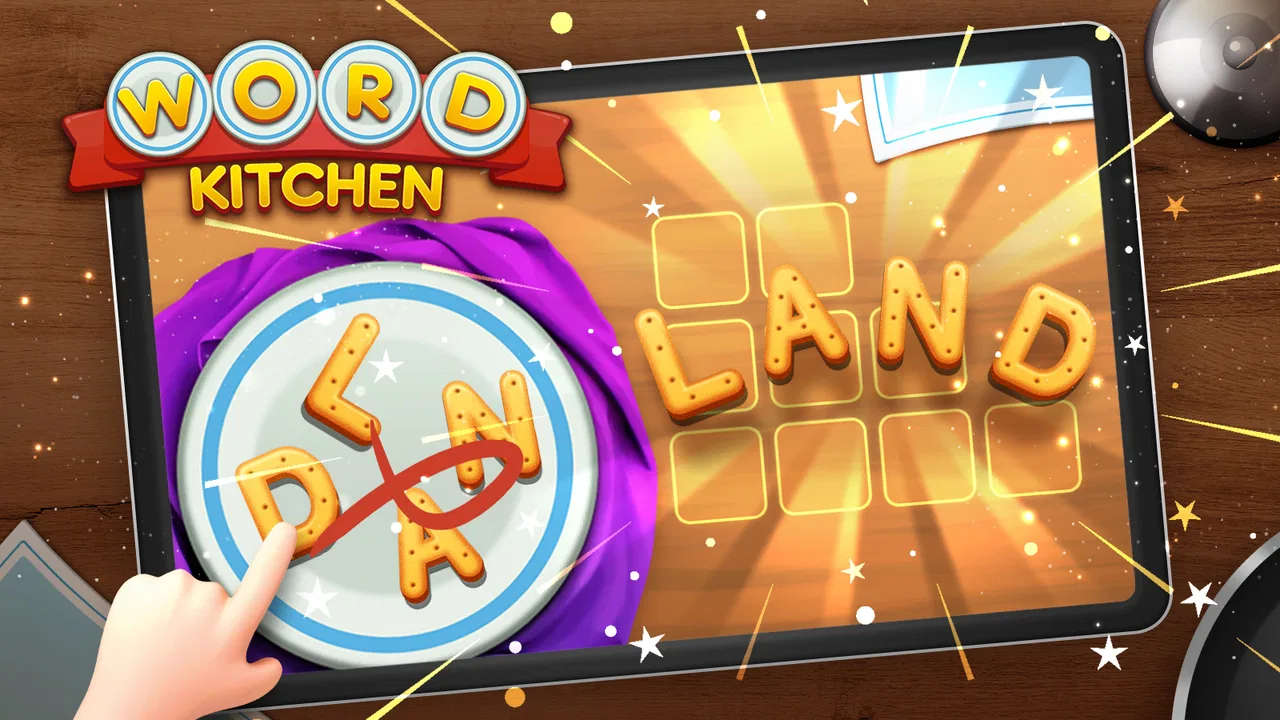
Word Kitchen
- 4.6
- Rating
- 1.00M
- Installs
- Free
- Price

 Analysis by App-foxy
I approached Word Kitchen as a quick word game rather than something I would play for long, uninterrupted sessions, and that turned out to be the right way to enjoy it. Its central idea is easy to understand: solve word challenges while working through a kitchen-themed setting, with each round asking you to think quickly but not demanding a large time commitment. The result is a friendly fit for spare moments, especially when I want something more active than scrolling but less demanding than a full strategy game.
Developed by Gimica GmbH, this free word game is aimed at Everyone and runs on Android versions from 7.0 onward. It has built a sizeable audience, with over a million installs, a 4.6 average from around thirty-six thousand ratings, and roughly a thousand reviews. Those figures suggest that its simple format has broad appeal, although popularity alone does not make every session equally satisfying. My experience was strongest when I treated it as a regular mental break, not as a replacement for a deep crossword or a competitive word board.
How I settled into the Word Kitchen routine
The baseline workflow is pleasantly uncomplicated. I open a level, look at the available letters or word prompt, and start testing combinations that seem likely to fit. The kitchen presentation gives the activity a little personality, but the real focus remains vocabulary and recognition. I do not need to learn a complicated control scheme before playing, which makes the first few minutes comfortable even for someone who rarely plays mobile games.
You May Also Like

 Blood Strike: 2.5 Anniversary
Blood Strike’s Loadouts Turn Every Drop Into a Tactical Gamble
A close look at Blood Strike’s custom loadouts: how fast access to signature weapons reshapes its battle royale rhythm, rewards preparation, and narrows the gap between fights.

 Pandora - Music & Podcasts
Pandora’s Music Is Easy to Start, but Harder to Recover
Pandora’s strength is its low-effort path from a seed to a station. Its weak spot is how much confidence it asks you to place in connection, setup, and quiet recovery.

 8 Ball Pool
 Is Built on Rivalries, Rematches, and Routine
A close look at the rivalries, rematches, shared routines, and unanswered safety questions that turn a quick pool match into a persistent mobile community.

 Samsung Music
’s Quiet Strength Is Playing What You Already Own
Its reach comes less from spectacle than from dependable access to a personal library. That simplicity is both the app’s strongest retention engine and its ceiling.

 AccuWeather: Weather Radar
AccuWeather Review: A Quick, Clear Forecast for Everyday Decisions
For everyday plans, the best forecast is the one you can understand quickly. AccuWeather makes rain timing, radar, and local conditions easy to act on, with a few trade-offs.

 Hill Climb Racing
Why Hill Climb Racing Still Turns Crashes Into One More Run
A tiny car, a bumpy hill and one more upgrade: Hill Climb Racing keeps resurfacing because its simple chaos makes every near-miss feel personal.
More From Our News Desk



What I like most is the low barrier between opening the game and making progress. There is no long tutorial to remember, and the basic action is familiar enough that I can concentrate on the words themselves. That makes it useful in situations such as waiting for an appointment, taking a short break from work, or winding down before bed. I can play a small portion, stop, and return later without feeling that I have abandoned a complicated plan.
That simplicity also defines the game’s limits. Players looking for a large vocabulary campaign with elaborate clues, story branches, or a strong competitive layer may find the experience light. Word Kitchen is better understood as a polished casual puzzle loop. It gives me a reason to keep solving one more challenge, but it does not try to become a full language-learning course or a serious tournament platform.
For a realistic everyday example, I would use it during a commute when I have only intermittent attention. If I am standing in a busy station, I can focus on one puzzle, put the phone away, and continue later. That works better than a game that requires a long battle or careful resource management. On a quiet weekend, however, I would probably choose a more substantial crossword, a word-board game, or a narrative title because this format can start to feel repetitive when played continuously.
The first useful habit is to avoid guessing randomly. I get better results by scanning the letters for short, familiar words first, then looking for longer combinations. Short words can reveal the game’s accepted vocabulary and help me notice patterns I might miss when I immediately chase the longest answer. This is not a secret feature; it is simply a more efficient way to approach the board and it reduces the frustration of tapping through possibilities without a plan.
I also recommend playing with a relaxed pace at the beginning. The theme may suggest urgency, but rushing often makes me overlook obvious letter arrangements. Once I understand the shape of a level, I can speed up naturally. That distinction matters for new players: the quickest route is usually not frantic tapping, but a brief scan followed by deliberate attempts.
Settings and purchase choices worth checking
Before settling into regular play, I would check the available in-game options and the device’s sound controls. Casual word games are often used in public places, so being able to manage audio comfortably makes a practical difference. I prefer a quiet setup when playing in a waiting room and a little sound at home, but I do not want the experience to depend on audio cues. The game remains readable as a visual puzzle, which suits short sessions in different environments.
It is also worth checking how the game presents optional purchases before becoming invested in a long run. Word Kitchen is free to download and includes in-app purchases ranging from $0.99 to $25.99 per item. I would treat those purchases as convenience choices rather than part of the basic reason to install it. Anyone who dislikes spending in free-to-play games should decide on a personal limit before playing, instead of making a decision in the middle of a difficult level.
That is especially important for families. The Everyone age rating makes the game broadly approachable, but an age rating does not replace supervision of purchases on a shared device. I would enable the device’s purchase protections and explain to younger players that optional items are not necessary for solving the core word challenges. This keeps the game’s casual nature intact and avoids turning a simple puzzle break into an unexpected spending issue.
Another setting-related consideration is notification behavior. I prefer not to let a word game interrupt unrelated tasks, so I would keep alerts limited if the device offers that control. A game like this works best when I choose to open it, rather than when it repeatedly pulls me back. That small adjustment helps preserve its role as a break and prevents the routine from feeling more demanding than the puzzles themselves.
The current version is 1.6.1, and the game was released on March 1, 2023. For day-to-day use, the more important point is to keep the app updated through the normal platform process when an update is available, particularly if a device is running an older Android release. It supports Android 7.0 and later, so it can suit older phones that cannot run many newer games, although the actual comfort of play will still depend on screen size, responsiveness, and available storage.
Patterns that make short sessions faster
My most reliable speed improvement comes from separating discovery from confirmation. First, I look for familiar prefixes, endings, and common two-letter combinations. Then I test the most plausible words instead of repeatedly rearranging every letter at random. This approach is useful because word puzzles often trigger a false sense that every possible combination deserves equal attention. It does not. Common structures deserve priority, while unusual possibilities can wait until the obvious routes are exhausted.
I also keep a mental distinction between a word I know and a word I merely suspect. When an attempt fails, I do not immediately assume the puzzle is unfair. I reconsider whether I have misread a letter, overlooked a shorter answer, or relied on a spelling that is not accepted. That short pause prevents a failed guess from turning into a string of equally uncertain taps.
Another practical habit is to use each level as vocabulary feedback. When the game accepts a word I did not initially notice, I remember its letter pattern rather than trying to memorize a giant list. Over time, I become quicker at recognizing endings and compact word shapes. This is a modest benefit, not formal language study, but it gives the game more value than simply filling a few minutes.
For players who tend to stall, I suggest changing the order of attention. Instead of staring at the entire puzzle, focus on one cluster of letters, form the simplest likely word, and then scan what remains. This reduces visual overload on a small phone screen. It is particularly helpful when playing one-handed, when glare makes the board harder to read, or when I am distracted by the surrounding environment.
I would not rely on speed alone as a measure of success. A slower solution that avoids unnecessary guesses can be more satisfying and more repeatable than a rushed attempt. If the game offers assistance during a difficult point, I would reserve it for genuine dead ends rather than using it automatically. That preserves the small sense of discovery that makes a word game worthwhile.
Compared with a traditional crossword, Word Kitchen feels more immediate and less dependent on interpreting a detailed clue. Compared with a word-board game, it is more solitary and usually easier to start without planning a full strategy. Compared with a spelling or vocabulary app, it is more playful and less structured as study. I would choose it when I want accessible word practice with a casual theme, but I would choose those alternatives when I need deeper clues, head-to-head play, or a deliberate educational progression.
Where experienced play still meets limits
After the initial novelty, the main question is whether the basic loop continues to feel rewarding. For me, it does in short bursts, but the repetition becomes more noticeable during extended sessions. The kitchen setting adds warmth, yet it cannot completely change the underlying activity: I am still solving one word challenge after another. Players who need constant mechanical variety may reach the game’s ceiling sooner than players who enjoy small, dependable puzzles.
The game is also not the best choice for someone seeking a serious test of broad vocabulary. Casual word games generally favor recognizable answers and quick pattern matching, and that is how I approach this one. If my goal were to study definitions, improve spelling systematically, or explore obscure language, I would select a dedicated learning tool or a more clue-heavy puzzle. Word Kitchen can encourage attention to words, but I would not treat it as a substitute for structured practice.
Its free-to-play structure deserves the same balanced view. Downloading it costs nothing, which makes trying it easy, and the optional item range leaves room for small or larger purchases. Still, anyone sensitive to prompts or convenience spending should pay attention to the purchase flow and decide in advance what “free” means for them. I prefer to play without assuming that every obstacle should be solved by spending, because the game is more enjoyable when I treat progress as a puzzle challenge rather than a transaction.
There is also a social limitation. I can recommend a level to a friend or play alongside someone, but the core experience is personal. It does not replace a shared word board where conversation and rivalry are part of the fun. That makes it a good companion for a solo break, not necessarily the right centerpiece for a family game night.
Players with older devices should consider comfort rather than compatibility alone. Android 7.0 support opens the door to many phones, but a small display or sluggish touch response can make letter selection less pleasant. I would test a few levels before committing to regular play. If the interface feels cramped, the problem is not the word design; it is that this kind of game depends on quick, accurate visual interaction.
Who will enjoy it most
I think Word Kitchen suits casual puzzle fans, people who enjoy finding familiar words, and anyone who wants a low-commitment game for small gaps in the day. It is also a reasonable introduction for a family member who is interested in word games but does not want the complexity of a crossword archive or a competitive word app. The Everyone rating supports that broad accessibility, while the simple workflow keeps the learning curve gentle.
It is less suitable for players who want a story with meaningful choices, a deep progression system, or a demanding multiplayer contest. It may also disappoint people who expect every session to feel fresh after long play periods. In those cases, I would lean toward a crossword app for richer clues, a board-style word game for competition, or a language-learning app for measurable study goals.
One overlooked strength is how easily it fits around interruptions. I do not need to reserve a full block of time or remember a complex state of play. That makes it useful for a parent waiting during an activity, a worker taking a short mental reset, or a traveler passing time between connections. The trade-off is that the same convenience can make it feel slight if I ask it to carry an entire evening.
I would also recommend it to players who enjoy building repeatable routines. A few minutes of word solving after lunch, during a coffee break, or before switching off for the night can become a pleasant habit. My preferred routine is to play without distractions, scan before tapping, save assistance for genuine blocks, and stop when the puzzles begin to feel automatic. That keeps the game mentally active without allowing it to become background noise.
My final view after making it a habit
Word Kitchen is at its best as a compact, approachable word break. I like that Gimica GmbH keeps the central action understandable and gives the game enough theme to feel friendlier than a bare letter grid. The broad audience, free entry point, and support for older Android devices make it easy to try, while the strong average rating and large install base show that many players have found the format appealing.
My recommendation comes with a clear condition: keep expectations aligned with the game’s scale. I would install it for quick solo sessions, light vocabulary exercise, and a gentle puzzle routine. I would skip it if I wanted deep clues, serious competition, formal learning, or a constantly changing set of mechanics. The optional purchases also mean I would set spending boundaries before playing regularly.
In practical terms, I would start with the free experience, review the sound and notification controls, and develop a scanning habit before considering any convenience item. Play in short sessions, use failed attempts as information, and compare the experience with a crossword or competitive word game if the novelty fades. For the right player, that approach turns a simple kitchen-themed puzzle into a reliable little daily challenge rather than a game that promises more depth than it can provide.
After using it this way, I can recommend Word Kitchen to anyone who wants an easy word game that respects short pockets of time. It is not the most demanding option in the category, but its accessibility is precisely its appeal. When I want a quick mental reset with clear goals and no complicated setup, it earns a place on my phone.
FAQs for Word Kitchen
01What is Word Kitchen about?
Word Kitchen is a fun and engaging word puzzle game where players connect letters to form words. The game challenges players with various levels of difficulty, encouraging vocabulary expansion and cognitive skills enhancement. With its inviting interface and smooth gameplay, it's perfect for word enthusiasts looking for a casual yet stimulating experience.
02Is Word Kitchen free to play?
Yes, Word Kitchen is free to download and play. However, it offers in-app purchases that can enhance the gameplay experience. These purchases might include hints or ad removals, allowing players to progress more easily through challenging levels. Players can choose to enjoy the game entirely for free or enhance their experience with these optional purchases.
03What platforms is Word Kitchen available on?
Word Kitchen is available for both Android and iOS devices. You can download it from the Google Play Store for Android users and the Apple App Store for iOS users. This ensures that a wide range of players can enjoy the game on their preferred devices, whether it's a smartphone or tablet.
04Does Word Kitchen require an internet connection?
No, Word Kitchen does not require an internet connection to play. This makes it a perfect option for those who want to enjoy a game while offline, such as during travel or in areas with limited connectivity. However, some features like in-app purchases might need a connection to function.
05How does Word Kitchen ensure user privacy and data security?
Word Kitchen is committed to user privacy and data security. The game collects minimal personal data, primarily for ensuring a smooth user experience. Players can review the app’s privacy policy for detailed information on what data is collected and how it is used, ensuring transparency and user trust.
Pros
- Engaging word puzzles for all ages.
- Visually appealing and user-friendly UI.
- Regular updates with new levels.
- Offline play available for travel.
- Encourages vocabulary expansion.
Cons
- In-app purchases can be pricey.
- Ads can interrupt gameplay.
- Limited hints can frustrate users.
- Some levels feel repetitive.
- No multiplayer option available.

Word Kitchen
Gallery